
 Tim Kencang.in
One question we often receive is: "Will using short links hurt my site's SEO?" The answer is no, as long as you use them correctly. This article examines common myths with direct references to Google's documentation, then closes with best practices.
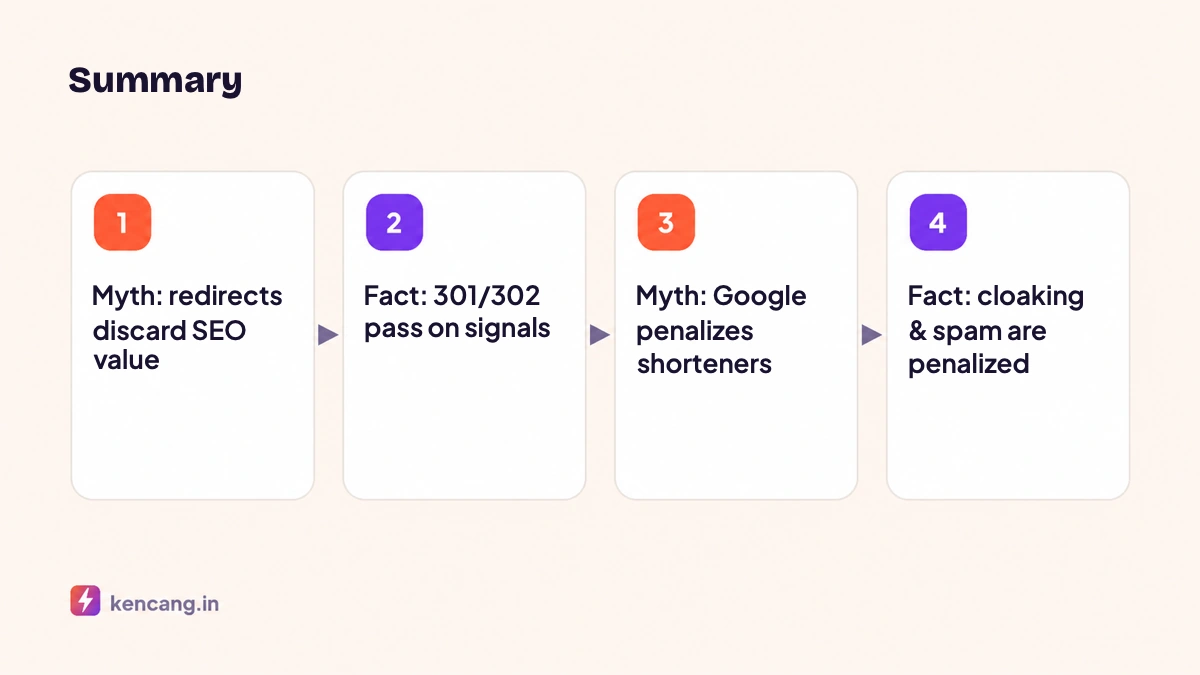
Myth 1: Redirects discard SEO value
Fact: Google states that both 301 and 302 redirects pass ranking signals to the destination URL. See the official documentation in Google Search Central's guide to redirects. The old concern about "losing PageRank through redirects" has been irrelevant since Google confirmed this years ago. A short link is essentially a redirect, so value pointing to it passes to the destination page.
Myth 2: Backlinks via shorteners don't count
Fact: Googlebot follows the redirect and associates the link with its final destination. However, the best backlink for SEO is still a direct link to your original URL from another site, as it is simpler and does not depend on third-party services. Use short links for channels that need them (social media, advertising, print, messaging), not to replace links in articles or partner sites.
Myth 3: Google penalizes short links
Fact: Misleading practices receive penalties: cloaking (showing different content to Googlebot and users), hidden redirects, and spam. These are explained in Google's spam policies. An honest short link leading everyone to the same destination violates no rules. Kencang.in also rejects links to dangerous sites; see the article on short link security.
Myth 4: Short links must use a 301 to be "safe"
Fact: Kencang.in uses 302 for links whose destinations can change, an appropriate choice: 302 tells browsers and crawlers not to store the destination permanently, so destination changes take effect immediately. For ranking purposes, Google treats long-term 302 redirects like 301 redirects. For an introduction to redirect codes, see what is a link shortener.
Where short links actually help
- CTR on social media and messaging. Clear aliases and branded domains increase clicks, and engaged traffic is a good signal for your business, even though it is not a direct ranking factor.
- Clean tracking. UTM parameters sit behind short links, keeping shared URLs neat and avoiding URL variants scattered across social media.
- Preventing dead links. When a page moves, update the short link's destination; printed materials and old posts keep working. Dead links create a poor user experience, and Google recommends avoiding them.
- Offline media. QR codes and short links in print bring traffic you could not get from long links.
Best practices to keep SEO safe
- Use original URLs for internal links and editorial backlinks. Short links are for distribution channels, not for site structure.
- One destination for all visitors. Country or device targeting is legitimate when content is equivalent and does not mislead; Googlebot sees the default destination.
- Do not add UTM parameters to internal links; this messes up analytics attribution, not SEO, but it's still detrimental.
- Fill in meta previews (title, description, image) on short links to ensure accurate preview cards on social media.
- Use a branded domain for long-lived links so that the link's reputation is tied to your brand.
- Monitor 404. Before deleting a short link that has circulated, point it to a relevant page for several months; see the article on expiring links.
What about bio pages?
Kencang.in bio pages render as HTML with crawlable titles, descriptions, and links, allowing them to be indexed like ordinary pages. Their links reach your destinations through redirects crawlers can follow. To prevent indexing, such as for an internal page, enable the private option. Find feature details in the article on bio pages.
Conclusion
Short links do not harm SEO; misleading use does. Use short links for what they do well: distribution, tracking, and flexibility, while keeping your site's link structure direct and clean. To get started, follow the basic guide to creating short links on Kencang.in.
Frequently asked questions
Do short links count as backlinks?
Googlebot follows the redirect and associates the link with its final destination, so the signal still gets through. Even so, for editorial backlinks from other sites, a direct link to the original URL remains the best choice.
Which is better for SEO, 301 or 302?
For ranking purposes, Google treats the two as equal in the long run. 302 is chosen for short links because it prevents the browser from permanently saving the destination, so that destination changes take effect immediately.
Can bio pages appear in search results?
Yes, because bio pages render as HTML with crawlable titles and descriptions. Fill in the title and description with relevant keywords, or enable the private option if you do not want the page indexed.
Is targeting by country considered cloaking?
No, as long as content across all destinations is equivalent and does not mislead users. Cloaking deliberately shows different content to search engines and users; honest regional targeting does not do this.